
Coleman Technologies Blog

Coleman Technologies Blog

We can give your organization comprehensive IT services and 24/7/365 live support for a predictable monthly fee. Stop stressing about technology, and start focusing on growing your business.

Tip of the Week: Reviewing Some Remote Work Best Practices


Figure Out Where and How You Work Most Effectively

As you work from home, it will help to establish one area of your living space as the area where work is to be done and commit to working there. Pick a spot that isn’t going to serve as an additional distraction (as the snacks of the kitchen and the temptation of a nap in the bedroom would serve) and claim that area as your productive workspace. Make sure that you have all the tools that you will need for your work in that area—from a laptop, an additional monitor, and any other peripherals that you will need for your tasks.

Once your workspace is settled, you need to settle how your day will be arranged. Unless the workflows of the office need to be maintained, try rearranging your schedule around personal duties. As long as the work is done on time, there’s no harm in giving your remote team a bit of freedom as you can.

Don’t Overwork

While work responsibilities may seem like a welcome escape for many from today’s stresses, you need to be sure that you are appropriately taking breaks and working the appropriate number of hours. Fatigue and burnout are just as big of an issue at home as they are in the office, so allowing yourself to step away on occasion is important to do, even as you work remotely. In fact, stepping away has been shown to inspire new ideas and progress, as well as improve overall physical health.

This means that you also must set a few firm boundaries. By requesting not to be disturbed during work hours, one can accomplish much more in the time allotted to them. As a result, the prospect of stopping at the end of the workday—another firm necessity—seems to be more manageable.

Make Sure You Have the Tools You Need

Sure, we may have already started discussing the hardware that one will need while working from home, but there are a lot of other aspects to consider. For instance, the software solutions that your team will need must be available to them as well. There are a few methods to doing so that you may choose from. You could have your team remote into your business’ network to access the software and data they will need, or you could make use of cloud solutions to effectively accomplish the same result.

Your team communication will become even more crucial than it currently is, so your team will also need the tools and resources available to collaborate with one another. Email works for certain things, of course, but should always be supplemented by an internal instant messaging platform and other tools to keep everyone on the same foot, like a project management system.

Remote operations will help you keep your business running and your team healthy, two incredibly important considerations for the near future. To learn more about the solutions that remote operations will require, or to start putting them in place, reach out to Coleman Technologies at (604) 513-9428 today.

Continue reading

Tip of the Week: How to Effectively Communicate with Your Clientbase


1.  Use the Best Tool for the Job

Your contacts should never find it difficult to reach you, so you need to make sure you’re providing them with plenty of options for them to make contact. Don’t pick between a phone number or an email address, give them both, along with a live chat feature, conferencing options, and other forms of communication. Making use of things like a blog and social media give you a great way to reach out to them first, starting the conversation.

With all of the options you can now give to your clients, they will feel much more confident about getting an answer to their questions and having their concerns addressed. They’re also apt to pay more attention to you as well.

2.  Automate as You Communicate

Of course, in doing so, you may make it more challenging for you and your team members to keep the conversation going with your clients while also accomplishing what needs to be done each day. After all, if your whole day is spent answering questions on the phone, it’s going to be a little difficult to do anything else. Fortunately, there are solutions that you can use to better manage all these communications. Automated phone systems can keep your whole team from being interrupted as a client plays phone tag, while following up with emails and other communications can help minimize the questions that clients ultimately reach out with and simplify their experience.

3.  Coordinate Your Team

For your business to provide a good experience for your customers and clients, your team all needs to work together as they deal with them to avoid repeating or contradicting messages. Improving your internal communications will only make your external communications stronger. Tools also exist to facilitate this, including instant messaging and customer relationship management (CRM) software.

For assistance in implementing this technology (and others), reach out to our team here at Coleman Technologies. We can discuss the tools that will suit your needs the most, as well as figure out how we can optimize them to your needs. To learn more, give us a call at (604) 513-9428.

Continue reading

Tip of the Week: 9.0 Pie Brings with It New Features


New Gestures
The latest version of Android OS contains a built-in new gesture navigation system, but it might not be turned on automatically. To turn this on, go to Settings > System > Gestures. Then you must tap on Swipe on Home Button and press the on-screen toggle switch. You will see the change propagate almost immediately--the three-icon setup will change to a singular pill-shaped icon.

Navigation isn’t much different from the other builds, either. Tap the pill icon to bring back the homescreen and long press it to bring up your Google Assistant. You can then swipe up twice or long-swipe from the home icon to bring up your app drawer.

Another change that needed to occur is that Android 9.0 Pie removes the dedicated button for recent applications. Users now need to singular short swipe up from the bottom of the screen to open up a carousel gallery that shows all recently opened apps. You can then navigate by swiping between apps or using the home icon to swipe fast-left or right to move through the apps more quickly. To clear the apps, swipe up on the specific app window. To clear all of the apps, just scroll all the way to the left and tap the Clear All button to exit out of all running applications.

Android 9.0 Pie actually tries to predict what you’re likely to need next. These commands are within the apps. If you find it useful, you can drag these suggestions, found at the top of your app drawer, onto the screen. You can then find the shortcuts offered by each app by long-pressing the specific application’s icon. This includes opening an application in split-screen mode, a considerable improvement from Android 8.0 Oreo.

Device Notes
One extremely useful feature for smartphone users is the ability to open your device using a fingerprint scanner, but an even better one is when you can use the scanner on devices that don’t feature an in-display fingerprint reader to keep your screen from turning off.

The alarm clock in Android 9.0 provides some additional functionality. When your notification panel is open (swipe down from the top), you only need to tap on the clock in the system tray to open your clock app and manage the alarms.

What do you think about Android 9.0? What are your favorite features? Let us know in the comments.

Continue reading

Tip of the Week: Three Pro Business Tips


Be Prepared to Lose Power
Electricity is perhaps the most important part of using technology in the workplace, as without it, the devices that empower your business’ operations just won’t function. In some cases, you might suddenly lose power, leading to data loss and other disaster scenarios that could strike your business down if you’re not prepared for them. With progress grinding to a halt, downtime will ensue, creating a considerable loss for your business.

Even if you’re not losing power, an excessive amount of it can create a surge, damaging the infrastructure itself and harming the individual components that make it up. It’s ultimately in your best interest to take measures against these events, as you made an investment that needs a substantial return. Surge protectors can be helpful to prevent excessive power from crippling these important machines, but in some cases, you’ll want a more powerful solution. An uninterruptible power supply, or UPS device, can help your servers, workstations, and other important technology shut down properly in the event of a power outage or surge, giving you the ability to minimize damage done.

Maintain a Steady Internet Connection
The Internet is an invaluable tool that can help your business succeed, and the Internet plays a larger role in its functionality than it ever has before. A lack of Internet ultimately becomes downtime for many organizations, as they depend on the Internet for various services and communications. More often than not, there’s nothing you can do about a lack of Internet if it comes from your service provider. To keep this kind of downtime from sinking operations, many businesses have implemented backup Internet connections, just in case they ever have to use it. This comes with a downside--you’ll have to maintain that connection--but it will likely be worth the investment if you ever need it.

Place Boundaries on Your Staff
Even the best employees are known to make mistakes from time-to-time. While you can trust them for the most part, nobody is perfect, nor should you expect them to be. Some might even try to implement their own solutions with the intention of making their jobs easier and more efficient. This is called shadow IT, and it can be dangerous. You have no way of knowing whether it’s putting your business at risk. You can implement measures to ensure that your employees aren’t downloading unauthorized applications through the use of administrator and user privileges. If you limit what your users can do with their machines, then you have less to worry about.

Coleman Technologies can help your business ensure managing IT doesn’t become a hassle. To learn more, reach out to us at (604) 513-9428.

Continue reading

Tip of the Week: How to Replicate and Relocate Text Easily


Once you have your content selected, whether it’s text or an image, all you have to do is press two keys.

To cut a word or phrase from one place in your content, press Ctrl + X. To copy this content instead, keeping the original and duplicating it elsewhere, press Ctrl + C. Pasting your content is just as simple - with the place you want the content added selected, press Ctrl + V. This will insert your content where you want.

If you happen to be copy-pasting from a website to another document, it may not be a bad idea to paste it without bringing any formatting from the website over. Otherwise, it is apt to look funny on your documents. Pasting without formatting is almost as simple as regular pasting, you just add another keystroke in the middle: Ctrl + Shift + V.

Of course, any of the tasks can be accomplished with the mouse alone. Right clicking on a word, an image, or a group of selected text will bring up a menu that includes all of the above options. However, your cursor is generally more accurate than the mouse, so you may have to undo your efforts (Ctrl + Z) a few times before it’s right.

Real World Example:
Let’s say you want to send a webpage link to someone in an email or instant message. In your web browser, click the address bar (that’s the part with the ‘http://… “). That will highlight the URL. Hold down Ctrl and press C. Then go into your email or instant messenger, click where you want to paste the URL, and hold down Ctrl and press V.

Whichever you use, it’s bound to be more time-efficient than rewriting anything that needs to go in a different spot. Make sure you subscribe to our blog, so you can be alerted whenever we upload more content!

Continue reading

Tip of the Week: How to Set your Default Video App in Windows 10


As with any applications on your device, you’ll have a variety of first and third-party applications that can be set as your default apps. Here are the steps to make this happen:

  • Click the Windows icon at the bottom left-hand side of the taskbar.
  • Click on the gear icon to open up your Settings.
  • Select Apps.
  • In the left-hand column, click on Default Apps.
  • In the right-hand side of the Default Apps screen, you can see the various types of files that will be opened by specific apps.

Changing your default video playback settings is also easy to do. From the Video playback option in the Apps section, you can enable streaming content at high dynamic range quality, process video for more enhanced quality, play back video in either a high or low resolution based on preference, and change how video is played based on battery life. You can pick from prioritizing video quality or battery life--whichever you prefer.

Before making any changes to your computer, we recommend speaking with the technology professionals at Coleman Technologies. This prevents you from making any changes to hardware or software settings that could cause frustrations for you and your staff. To learn more about the services we provide, reach out to us at (604) 513-9428.

Continue reading

Tip of the Week: How an Android User Can FaceTime, Sort Of


Tip of the Week: How an Android User Can FaceTime, Sort Of

When it comes to exclusive user features, one of the better-known ones on the Apple side of the house is FaceTime, a video chat platform. Apple has however made certain features of FaceTime available to Android users, but they come with a catch. Let’s go over how an iPhone user can FaceTime with an Android user, even if some of the features are not quite there.

It’s important to preface this blog by stating that Android users cannot initiate a FaceTime call. The user of the iPhone in question will have to start the call. Basically, what happens is that the Android user will use a specific link to join the FaceTime call in much the same way you would join any typical video conferencing call. Here’s how to get your link.

We’ll start from the iPhone user’s perspective to generate the link. They will have to go into the FaceTime application to select the option for Create Link. This will be available in the top-left menu. The user then sends the link to the Android smartphone. This can be done through text, email, or whatever other method you might use.

After the recipient has the link, they can use it to open the FaceTime web application on their device. Since it is a video call, know that it will need access to your microphone and camera in order to work properly. Once the user has added their name to the call, they can join by tapping on Continue.

Now that the Android user has gotten to this point, the iPhone user can see the option to accept or reject the call.

And now, the call can proceed as usual. The call works mostly the same way as your typical FaceTime call would, but with some feature limitations placed on the Android user. You should be able to enjoy your FaceTime calls no matter the device used by whoever is on the other end of the call!

Of course, FaceTime is far from a business-grade video chat platform, so if you’re using it to conduct business as usual, perhaps it’s time to invest in a video collaboration platform for your business instead. These platforms also won’t be nearly as restrictive or as limited by the type of device used by your workers, meaning that anyone can collaborate in the same way.

Hopefully you find this tip of some help. If you want additional assistance with collaboration platforms or further tips and tricks, be sure to call us at (604) 513-9428.

Continue reading

Tip of the Week: What Happens when a Laptop is Left Plugged In?


For this week’s tip, we’ll dig into this exact question.

How Working from Home Has Impacted the Use of Mobile Devices

Here’s the thing: with stay-at-home orders and other measures being put into place across the country, a lot of people aren’t as mobile as they once were. As a result, the mobile devices that would travel with them back and forth to the office have effectively become temporary desktops in their homes… and as such, are spending more time plugged in than not.

So, Is This a Problem?

That depends on a variety of circumstances, the first of which being the age of your device. Not all that long ago, leaving your laptop plugged in could overload and damage the battery (which was not a good thing by any means). Today’s batteries, made of either a lithium-polymer or lithium-ion, won’t behave that way. Instead, once a device’s battery reaches full power, any additional power brought in will instead power the laptop itself.

However, this doesn’t mean that there aren’t some concerns to doing this.

Any laptop user has likely noticed that, after their device has been charging for so long, the bottom will get hot. While this is to be expected, too high heat for too long can damage the device, impacting the battery’s performance. One study, performed by Battery University, indicated that leaving a laptop that’s fully charged plugged in at different temperatures can bring down the battery’s capacity over time.

Therefore, to answer whether it is safe to always leave your laptop plugged in, the verdict is now yes… so long as it is in a cool and well-ventilated area. Otherwise, you’re apt to run into problems.

Coleman Technologies is here to offer you other useful advice for managing your technology properly, even while your team is working remotely. To learn more about the services and solutions we can provide, reach out to us at Coleman Technologies.

Continue reading

Tip of the Week: Are Workplace Wellness Programs Effective? It Depends


Study after study has been performed over the years about the impact of workplace wellness programs, producing various results. Some have indicated health improvements and cost savings, while others haven’t. However, the studies that were performed in the past had a high rate of issues. Whether there was no comparison group, or the chance of personal bias influencing signups, these studies simply didn’t provide reliable data.

Now, however, researchers from the University of Chicago and Harvard have conducted a large-scale study that meets the requirements that such a study is usually beholden to.

The BJ’s Wholesale Club Experiment

This experiment began by selecting 20 of the big-box retailer’s outlet centers to offer an employee wellness program. 140 additional BJ’s locations did not offer any such program. Across the 160 clubs involved, there were almost 33,000 workers employed.

Participants filled out a health risk questionnaire, took health classes, and had basic medical tests performed. After 18 months, their progress was evaluated...and that’s where things got interesting.

Despite the workers who were participating in this program reporting healthier behaviors than they once exhibited, almost all other factors were left unchanged. Blood sugar levels, job performance and attendance, and employer health care spending all were unaffected.

Why This Might Be

There’s a good chance that the results of this study were skewed by the incentives offered to participants. Participants were given gift cards for attending wellness courses, for a total incentive of about $250. According to founder and CEO of Bravo Wellness, Jim Pshock, this may just not have been enough. According to Pshock, any amount less than $400 is only going to be enough to incentivize people to do what they were already going to do anyways. As Pshock put it: “It’s simply too small to get them to do things they weren’t already excited about.”

Another study, published in 2018 by the University of Illinois, essentially debunked the idea of the workplace wellness program, concluding that it neither reduced costs or impacted behaviors - although this study also found that participants of wellness programs were those who were already healthy and motivated. This potentially suggests that the true benefit of these programs isn’t to make their existing workforce healthier, but to attract and retain healthier employees.

There are other potential contributing factors as well. A recent survey indicated that 84 percent of employees saw their wellness programs as “one-size-fits-all,” a concept that doesn’t really work will all of the various factors that contribute to health. Eighty percent of respondents to that same survey claimed that more personalization would contribute to their participation in wellness programs.

Why You Want to Adopt a Workplace Wellness Initiative

Admittedly, we’ve provided a mixed defense for these kinds of activities, but it cannot be denied that anything you can do to promote the health of your employees will only benefit your business - healthy employees tend not to call in sick, after all.

There are other benefits to these programs as well:

  • Reduced Stress - The stress management benefits of healthier behaviors have been well documented. By adopting these healthier behaviors, you and your staff can reduce the stress that comes from the office and approach the source issues more effectively.

  • Community Building - As the boss, you want your entire team to work as, well, a team. Unfortunately, if certain departments don’t work together much, this kind of relationship can be hard to develop. However, many activities that would fall under a workplace wellness initiative can help cross departmental lines, drawing your team closer together.

  • Better Moods - Wellness programs allow employees to try out new activities, which can not only add to their wellbeing, but can also keep them engaged and productive. Plus, studies have indicated that employees who participate in these programs were generally happier with their work situation.

What have you done to cultivate a more health-conscious workplace? Share your strategies in the comments!

Continue reading

Tip of the Week: Reopening Closed Chrome Tabs and Windows


Tip of the Week: Reopening Closed Chrome Tabs and Windows

How often does this scenario happen to you? You’re going about your workday and are being quite productive, when all of a sudden you close the wrong tab in your web browser, putting an end to your productivity. This isn’t crippling downtime or anything, but it’s an inconvenience that we know you can do without. Thankfully, modern web browsers let you reopen closed tabs or windows to get back to where you left off.

How to Reopen a Closed Tab or Window in Google Chrome

For the purposes of this tutorial, we’ll use Google Chrome for our examples, but know that the other popular web browsers have similar functionality, and the process is similar if not identical to perform the same tasks.

First, close out one of your other web browsers. Go ahead, do it. We’re confident you can get it back, as long as you’re not filling out a form or there is other sensitive content on it that must be re-entered. After you’ve closed the tab or window, right-click the Plus icon as if you were going to open a new tab. You’ll see an option for Reopen Closed Tab. This will reopen the last closed tab, just like it says. You can even do this multiple times for multiple tabs, too.

For a quick reference, you can use the keyboard shortcut as well: Ctrl + Shift + T.

Reopen a Closed Window in Google Chrome

But what if you accidentally close the entire window without realizing it? Thankfully, Chrome has functionality for this, too, and it’s just as simple. Go ahead and open up a new window for testing purposes. Next, close out of it by clicking on the X button in the top right corner of the window. Go back to your current browsing session and right-click the tab bar at the top of your screen. If the last thing you closed was a different window, you’ll see the option for Reopen Closed Window. Go ahead and click it. Your closed window should reappear.

The keyboard shortcut for this is just as easy: Ctrl + Shift + W.

That’s all there is to it! It’s a simple but helpful tip to be just a little more productive with your day.

What other tips would you like to see us write about on our blog? Let us know in the comments, and be sure to subscribe.

Continue reading

Tip of the Week: Selecting the Right Data Warehouse for Your Needs


To begin, let’s figure out exactly what a data warehouse is.

Understanding the Data Warehouse

A Data Warehouse isn’t to be confused with a Data Center, where you might store your server infrastructure. It is a system for analyzing and reporting on large amounts of data. It helps you predict trends and get a full picture of what’s going on with your business.

In order to understand the purpose of a data warehouse, it helps to look to warehouses in the real world. In short, it’s a place to store stuff.

While this may seem simplistic, it is key to the other functions of a data warehouse. By storing all of a business’ data in a central location, that data can all be referenced against each other - regardless of the original source. This means that you can use this data to generate better analytics than you may have gotten otherwise, simply because you are less limited by the data you have access to.

Selecting a Data Warehouse

Of course, not all data warehouses are the same, and the different types offer different utilities. You also have to consider if the data warehouse itself is sufficient. Let’s go over some of the considerations you will have to make during your deliberations.

What kind of data do you need to store?

For our purposes, data can be split into two types: structured and unstructured.

  • Structured data is data that can easily be organized into a spreadsheet. If your data fits the bill, a relational database would likely be a good fit for your needs.
  • Unstructured data (or semi-structured data) is data that is presented in less-uniform formats, like geographical data, emails, books, and the like. If you have a lot of this kind of data, you may want to consider utilizing a data lake over a data warehouse.

How immediate does your data need to be?

Your intended use of your data warehouse will have the largest impact on this consideration. Are you looking for business insights, or are you more focused on real-time analytics? If you are looking to find out more about your business, having more data available will give you better answers. If you are using the data warehouse to fuel a predictive analytics platform, you will need less data, as tracking trends can be done with a simple Relational Database Management System (RDMS) and won’t necessarily benefit from access to all of the data your organization stores.

How are the costs structured?

Different data warehouse solutions are priced based on different factors, usually combining the storage used, the size of the warehouse, the number of queries that are run, or the time spent leveraging the solution. Your particular use case will likely influence which solution is most cost-effective for you, whether frequent utilization makes a lower compute cost preferable or a high volume of data makes lower storage costs the logical choice.

Does it work with the tools you use?

Finally, you need to be sure that the solution you are considering is compatible with your business’ other solutions - otherwise, you won’t get the full value from your data warehouse (or create more work for yourself).

Coleman Technologies can help your business manage its technology needs. To learn more about how we can optimize your business processes, call (604) 513-9428.

Continue reading

Tip of the Week: What Google Lens Can Do


Explaining Google Lens

Downloadable from the Google Play Store, Google Lens is a utility app that incorporates artificial intelligence to make your smartphone’s capability to take and store images even more useful. With Google Lens, your phone can identify the elements in an image and give the user in-depth and contextual options based on it. Let’s say you wanted to find out what the flowers were that someone had planted outside their house. Using Google Lens, you could point your camera at the flowers and identify them that way.

Now, just consider how this could be applied to the modern, mobile workplace:

Copy and Paste Real-World Text

The ability to copy and then paste content is one of the most often-used functionalities in the office, so why not bring it to the physical world (sort of)? Using Google Lens, you can capture text with your camera from any media just as though it was content on a website. Simply press on the desired text to select it, press the Copy button at the bottom of the screen, and there you are. This text can then be shared directly to the clipboard of any computer with the same Google account actively logged in.

Extract Contact Information from a Business Card

While business cards are a great way to build business relationships at networking events, they don’t exactly fit in with most of today’s business environment. Lens can fix that by capturing the details printed on the card and giving the user various options. Whether you want to call the contact shared on the card, visit a website printed on it, or send a quick text or email message, Lens makes it simple to do so.

Create a Calendar Event

While calendar events are a great way to keep one’s schedule organized, helping one fulfill their obligations, they can become arduous to input into a mobile device. Google Lens can automate that process, pulling the necessary information from a flyer, an appointment card, or any other media and giving the user the option to Create calendar event.

Of course, this has been but a brief sampling of Google Lens’ capabilities. We encourage you to download it and see how much it helps you. If you’ve used Google Lens before, let us know how it worked out for you in the comments!

Continue reading

Tip of the Week: Sharing Web Pages Between Chrome and Android


Tip of the Week: Sharing Web Pages Between Chrome and Android

It probably isn’t hard to think of a time when you’ve stumbled across something that would be useful for work while you were doing some personal browsing. What if I told you there was an easy way to send a website to your browser to view later? Thanks to Google Chrome, this is the case.

Let’s discuss how you can use Chrome’s multi-platform nature to your advantage to access the same web page on different devices.

Chrome Users Have a Few Options to Push Web Pages Between Devices

First off, simply being signed into the same Chrome account gives you the option to access a page from your history, as activity from all devices will be tracked. All you have to do is access Chrome and open History by pressing Ctrl+H when using a computer, or accessing Recent tabs from the three-dot menu in the Chrome mobile application.

If you’re in the process of reading something, however, and want to proactively have it ready on another device to continue viewing it, Chrome also supports this. When using the desktop, there’s a small icon in the address bar that looks like a corner with an arrow emerging from it. Clicking this icon, or alternatively right-clicking on the browser tab’s title will give you the ability to Send to your devices, with a list of all devices you’re signed into appearing for you to select from. If you’re on an Android device, access the three-dot menu and select the Share option. You’ll be provided a variety of options, including one to Send to your devices.

We’re committed to doing anything we can to help make your time in the office easier, whether it's through tips like this or through our comprehensive IT services. Learn more about the latter by giving us a call at (604) 513-9428 today!

Continue reading

Tip of the Week: Adjusting Microsoft Word to Match Your Style


Before we get started, we want to make sure that you know to consult with your IT department or provider before you go to make any of these changes. That way, they will be able to undo any mistakes you or your employees might make during the following processes.

Customizing Word’s Rules to Meet Your Preferences

It’s likely that there are some things that you regularly type into Microsoft Word that it may not agree with. Your company’s name might not exactly jive with the grammatical rules that the rest of the language should subscribe to, for instance, or you may prefer to stylize certain terms or phrases differently. Word isn’t going to like this, and is going to try to let you know that a mistake has been made. Of course, it might also just change the word you typed to what it is “supposed” to be.

These corrections can be a pain to repeatedly make, and there’s always the chance that one will be missed. Fortunately, Word offers you the opportunity to “teach” it new rules via a fairly simple process.

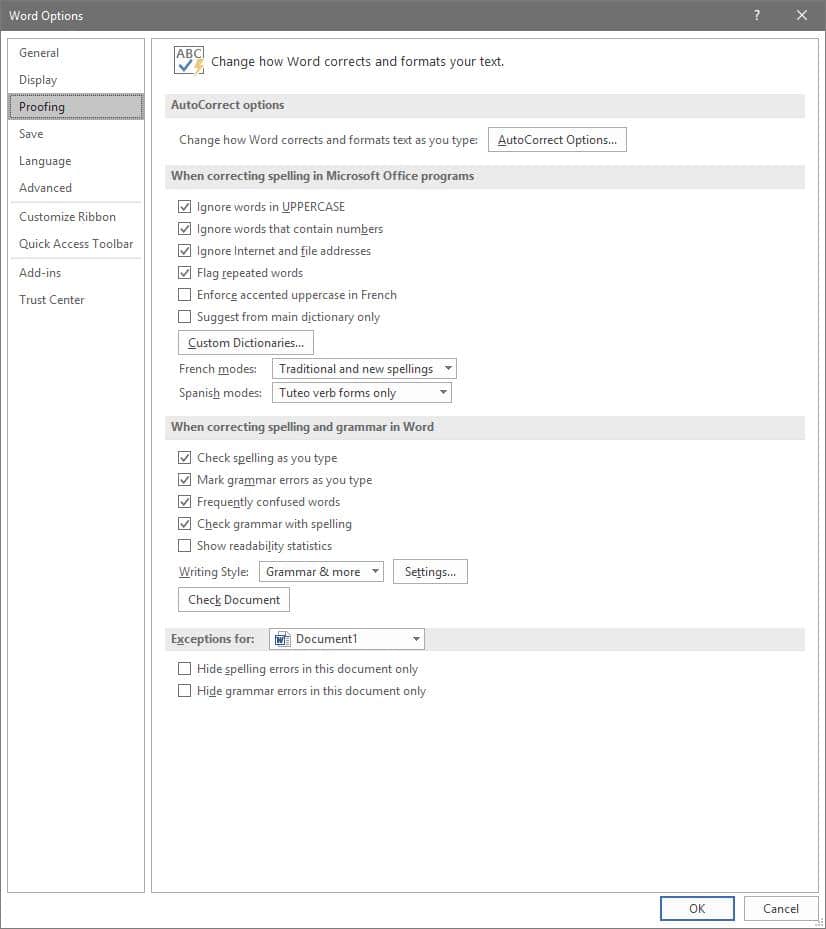
To access these rules, select File, and from there, Options. A new window should pop up with a Proofing option in the list. That page looks like this:

Adjusting AutoCorrect

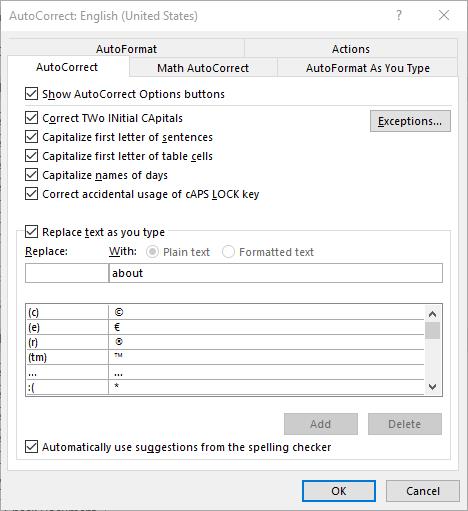
Here, you can alter a variety of proofing options, including your AutoCorrect Options. Clicking that button will present you with another window.

This window allows you to set your AutoCorrect rules, identify any exceptions you might want to make, and review how misspelled text can be automatically revised.

Establishing Grammar Rules

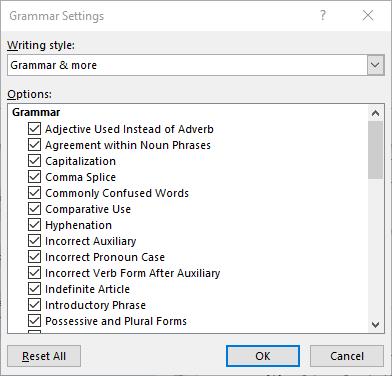
Returning to the Proofing List window, you also have other options that allow you to adjust Word’s corrections. For instance, clicking the Settings... button under When correcting spelling and grammar in Word provides another window. From here, you can control which grammar rules Word will flag or ignore in your copy.

Stop Worrying About Word Changing What You Write

By implementing these changes, you can prevent small annoyances from interrupting you as you work with Microsoft Word. This way, you can accomplish more without having to worry about dealing with automatic corrections again.

For more tips on how to best leverage your solutions to save you valuable time and money, subscribe to our blog!

Continue reading

Tip of the Week: Four Fundamental Small Business Tech Tips


1. Adopt Technology Solutions

Regardless of your industry, who your business serves, or even where you operate, there are some universal changes that technology has brought to how the average small-to-medium-sized business functions. Methods of collaboration have shifted to digital formats, “coming to work” is no longer a prerequisite to working, and the filing cabinet has been rendered woefully obsolete by other, better options. Cloud solutions are a major contributor to this. I want you to take a moment and consider something: why were any of these changes made in the first place?

It is for the same reason that the assembly line process was adopted, or why we cook our food before eating it: it provides greater benefits than the old way. It is the same with business technology, and you will see this as a common theme throughout these tips. Don’t disqualify yourself from competing by removing your ability to do so.

2. Don’t Shortchange Email

Email is now the gold standard for business communications, for numerous reasons. While a small business might find it redundant to email an announcement, doing so can prove useful to their operations. For instance, let’s say Mary manages a small office with four or five employees. She could easily just announce an important message to the room, but what if James was at the dentist that day, or Rob had excused himself to the bathroom just before? What if Ellen had just connected for an important phone call?

Email provides an easy way for you to communicate with others in your workplace that ensures everyone gets the message, without disrupting operations too much.

3. Go Mobile

While we’re on the subject, let’s consider Ellen for a moment. In the past, making a phone call would tie her to her desk, so any distractions in the office would be an unavoidable issue. Nowadays, there are many ways that Ellen could hypothetically remove herself from the situation while still fulfilling her responsibilities. For instance, a Voice over Internet Protocol solution could allow her to make and take calls from anywhere she could establish a connection, so she could presumably find a quieter area to work without sacrificing her ability to do so.

Other solutions also offer some form of mobility, assuming they are backed up with enough security. For instance, if James was unable to get to the office after his dental appointment, he could still work on his assigned tasks from home with the right cloud-based solutions.  Again, this helps eliminate his reliance upon getting to the office in order to produce.

4. Don’t Underestimate the Cloud

We’ve already touched upon how the cloud has shifted businesses, primarily focusing on how useful it is for hosting and storing data. However, this isn’t the only thing the cloud can do. Cloud technology enables today’s businesses to make use of tools that would ordinarily be out of reach. Yes, its storage capabilities can help make data more accessible to team members who need it, but it can also assist you in preserving your data in case of some disaster, give you access to computing resources that you couldn’t procure yourself, and provide you flexible access to your business applications.

5. Improve Your Security

A small business’ size once protected it from cybercrime, but nowadays, all businesses are fair game. In order to remain secure against these attacks, the right defenses need to be put in place. Things like firewalls, spam blockers, antivirus, and assorted other solutions help to reduce these risks. Additionally, any employee could potentially let in a significant threat, so all need to be educated on how to spot them, and the proper procedures to dealing with them.

Coleman Technologies is here to assist you in implementing these modern IT essentials, as well as maintaining them for you through our remote monitoring and access capabilities. To learn more about how else we can help your growing business, give us a call at (604) 513-9428.

Continue reading

Tip of the Week: Keyboard Shortcuts for Convenient Browsing


If you want to try them out as you read along, make sure you open a new browser window… we don’t want you leaving this page before you read all of them!

Jump to Address Bar: Ctrl+L

Let’s say that it’s the beginning of your day, so you are checking your email for the first time. Afterwards, you know that you need to go to a particular website. Windows offers a quick shortcut that selects and clears the address bar so you don’t have to even stop typing before you move along. To make the jump, simply press Ctrl+L.

Quickly Add the Dot Com: Ctrl+Enter

Let’s use an easy example for this one, like the official website of the 1996 movie Space Jam. Visiting this website is as easy as typing in “www-dot-spacejam-dot-com,” but this shortcut allows you to just type in “spacejam” instead. Pressing Ctrl+Enter will automatically add the “www-dot” and “dot-com” in for you.

Open a Search in a New Tab: Alt+Enter

Of course, a lot of searches come about as something else is being done online, and that something isn’t always something you can navigate away from. If you’re trying to open a new website up or perform a search in a new tab, pressing Alt+Enter rather than just the latter will open what you typed in a new tab.

These two shortcuts also work together, so pressing Ctrl+Alt+Enter after typing “spacejam” would add the missing domain information and navigate to it in a new tab.

Open Clear Browsing Data: Ctrl+Shift+Delete

Finally, when you’re all done browsing the Space Jam website (or whatever else you may have used these tips to do), you can more conveniently open your option to clear your browsing data.  Pressing Ctrl+Shift+Delete will bring you to the requisite screen for you to press the button.

Before you navigate away from this page, make sure you subscribe to our blog for more useful tips and time-saving best practices!

Continue reading

Tip of the Week: Easily Close Browser Tabs


Tip of the Week: Easily Close Browser Tabs

It’s easy to open up far more tabs on your web browser than you need, especially when so many tools are cloud-based. If you find yourself in need of a quick way to close all other tabs besides a handful or so, we’ve got just the tip for you. You can close all open tabs to the right of your preferred window, or you can close all tabs outright.

Close All Other Tabs

If you have one specific page that you want to remain open, then it’s very easy to close all other tabs that you have open. All you have to do is right-click on your chosen tab and select the option for Close Other Tabs. You’ll notice that all other tabs will close, leaving you with just your chosen tab open.

Close Tabs to the Right

If you want to leave multiple tabs open, however, you can do this pretty easily, too. You can close all tabs to the right of your chosen tab. Just take a moment to organize your tabs so that all the ones you want to close are on the right side of any particular tab. To close them all out, right-click on the chosen tab and select Close Tabs to the Right. All tabs to the right side of this tab will close out. Pretty handy, huh?

Sometimes it’s the little tips that make a big difference in the way you go about the workday, and this one can potentially save you loads of time and frustration. For more great tips and tricks, keep your eyes on our blog feed.

Continue reading

Setting Up One of the Most Important Devices in Your Business


Setting Up One of the Most Important Devices in Your Business

Setting up a router used to be a much more complex process than it is today. Thankfully, innovations in the technology have made it simpler and easier for consumers and businesses alike to do, to the point where some Internet service providers just let users do it themselves with guided instructions. Let’s go over how you can get the most out of your wireless router.

Place Your Router in a High-Up, Unobstructed, and Centralized Location

The placement of your router is crucial to your organization getting the most out of it, and it’s mostly because of how Wi-Fi signals work. These signals ripple out from the device, radiating outward from the central location and growing weaker in the process. You should keep it centralized to make the signal reach all parts of your office.

To help the signal along, you also need to make sure that it’s not blocked by anything by keeping a clear line of sight between the router and your devices. Thus, keeping it elevated and out in the open rather than a cabinet or a closet is the best way to go here.

Update Your Router and Its Firmware with Patches

Your router is an easy-to-overlook technology that, while not as complex or dynamic as a computer, still runs on software and, thus, requires patches to stay secure and operational. Outdated security protocols could make your wireless network vulnerable, and outdated firmware might mean that your router is simply not performing as well as it could be. If you want to get the most out of your wireless technology, then keeping your router updated is crucial.

Keep Separate Connections for Personal Devices

You’ll want to keep your personal devices off of your business network, mostly because you don’t want guests and visitors using bandwidth that your employees should be using. Furthermore, letting anyone access your network can be considered a security risk, and limiting who can access your business’ network can be a good step toward keeping it secure.

Coleman Technologies can help you set up a wireless network that aids your company’s efforts at success. To learn more, call us today at (604) 513-9428.

Continue reading

Tip of the Week: Helpful Outlook Tips


Consolidate Your Email with the Clean Up Tool

Businesses will often use email to communicate between groups of people, which is a really useful practice for keeping people apprised and in-the-know of what’s going on. However, these messages can quickly become repetitive, incoherent messes--especially in chains made up of larger groups--as participants reply to them, duplicating the thread within itself. Outlook includes a utility known as the Clean Up tool to fix these problems in your email conversations, and even in entire email folders.

By finding the Clean Up icon in the ribbon at the top of your Outlook window, you can access a drop-down menu. This menu offers to Clean Up Conversation, Clean Up Folder, or Clean Up Folder & Subfolders. Once you’ve confirmed your choice, you can access Clean Up settings, which allow you more granular control over how the tool sorts through your existing conversations.

Schedule Out a Message with Future Delivery

Sometimes you’ll have an opportune moment to send an email, but it isn’t the right time for this email to be received. For instance, if you want to share something with your employees to keep in mind throughout the next day, it doesn’t make sense to distribute it at the end of the day before for it to be forgotten. Outlook allows you to use your opportunity to your full advantage with Future Delivery.

Once you’ve written an email, click on Options, and then Delay Delivery. This opens a Properties box for that specific message, including Delivery Options that include a checkbox labeled “Do not deliver before.” Selecting this option and specifying a time and date will prevent your recipient from receiving your message before that point. Once you’re satisfied, close the Properties box and send the message just like any other.

Taking Advantage of Shortcuts

Keyboard shortcuts are used to simplify access to commonly-used functions in many computer programs and applications, and Outlook is no exception. For instance, Outlook features shortcuts for a wide range of its functionality - covering the basics (like composing a new message by pressing Ctrl+Shift+M), organizational tools (like moving a message with Ctrl+Shift+V) or annotating your messages (like adding flags to important ones with Ctrl+Shift+G).

This is really just the start of Outlook’s capabilities to help your operations. Subscribe to our blog to find out whenever we post other tips or IT blogs.

Continue reading

Tip of the Week: Is a Laptop the Best Fit for Your Employees?


Reason 1: Mobility
Let’s begin with the most obvious reason laptops are a great option - you aren’t tied to a desk to do your work as you would be with a conventional desktop. Instead, you can just pick it up and take it with you, whether that’s to a meeting on the other side of the office or home for some remote work. I don’t know if you’ve ever seen someone haul an entire desktop workstation around, but if you have, you know that it just isn’t practical to do.

Potentially travelling with a laptop is also much easier. A desktop workstation would need to be carefully stowed in a vehicle, if not shipped to its destination. While it may seem like a hassle at the airport, stowing a laptop in a carry-on is a much more secure and convenient option when all is said and done.

In short, utilizing a laptop makes a lot more sense in an increasingly mobile world than does utilizing its far less mobile cousin, the desktop.

Reason 2: Concision
If the resources are there, one might make the argument that it makes more sense to utilize both a desktop and a laptop - one for the office, and one for home and travel.

Financial considerations aside, there are other issues with this strategy. The major one is the fact that it makes it that much more complicated to ensure that everything you need is where you need it to be, when you need it to be there. There is little that is more professionally frustrating than sitting down to work and realizing that the data you need is on your other device. Hopefully, you have the access to the other device at the time to make the necessary transfer.

While properly utilizing a cloud solution would be another way to approach this difficulty, why use two devices when one will suffice? That way, you can be sure that your employees always have access to the programs and data that they need to be productive.

Reason 3: Consistency
One of the most important considerations for any office technology configuration to take into account is how compatible the many devices it contains are with each other, and the solutions needed to accomplish each day’s tasks. If each employee has a different device, not only is this no longer guaranteed, you have no guarantee that each laptop will have the same shortcuts and features. For instance, if you want to encrypt the data on laptops and allow your staff to sign in with a thumbprint scanner, not all models are equipped with that. Different devices don’t tend to change how complicated it is to manage the devices, but it can vary the experience your users have and limit the policies you can set.

Standardizing your office’s devices becomes much easier when everyone has the same device, which inherently means that everyone has the same capabilities in the office. Of course, if someone needs their device to have more specialized capabilities, they should be the exception. However, for the run-of-the-mill tasks that many are responsible for, the average laptop should suit them just fine.

If you want more help in designing your technology infrastructure and setting it up for prolonged productivity, reach out to Coleman Technologies. One call to (604) 513-9428 is all it takes to start receiving the technology services that you need for success!

Continue reading

About Coleman Technologies

Coleman Technologies has been serving the British Columbia area since 1999, providing IT Support such as technical helpdesk support, computer support and consulting to small and medium-sized businesses. Our experience has allowed us to build and develop the infrastructure needed to keep our prices affordable and our clients up and running.

get a free quote

Understanding IT

Get the Knowledge You Need to Make IT Decisions

Technology is constantly evolving, and keeping up can feel overwhelming. Whether you want to understand cybersecurity threats, explore automation, or learn how regulations like PCI DSS impact your business, we’ve made it easy to access clear, straightforward insights on key IT topics.

Insights to Understanding IT

Contact Us

20178 96 Ave C400
Langley, British Columbia V1M 0B2

Mon to Fri 7:00am–5:00pm

[email protected]

(604) 513-9428

Coleman Technologies Awards & Memberships

Image
Image
Image